Showing posts with label money. Show all posts

Tuesday, August 20, 2019

Apple Card Credit Card Signup

I signed up to receive an Apple Card, today. The entire process, from applying, through approval, to receiving the new card in my Apple Wallet took less than ten minutes.

Once I received it in my wallet it was active to use with Apple Pay. I also requested to have the physical titanium card sent to me which should take about a week.
Customer support via text message

I was wondering if the Apple Card had a virtual account number similar to my Citi Mastercard. There was a button to call or text for help which was great. Nothing better than getting customer support via text message – no wait or hold time.

Unfortunately, the Apple Card can only generate one number at a time which can be easily changed by pressing a button. So, at this time, it seems that I can only have a single credit card number active with Apple Card.

Another disappointment was that Apple Card interest rate depends on credit worthiness, somewhere between 12.99% - 23.99%. My FICO score is over 810, so I would have hoped for something lower than 17.99%. But it's been more than a decade or two since I've carried a balance from, month to month, on my credit card. So, this shouldn't be an issue for me.

A nice thing about the Apple Card was that I could tap one button any all of my Apple bills (iCloud, iTunes, etc) were switched to my Apple Card which returns 3% cash, daily. Let's see how it works.

Monday, June 12, 2017

My Luck With Banking

Last month, I withdrew $200 from a San Diego ATM. Unlike New York, where ATMs dispense $20, $50, and $100 bills, San Diego's ATMs have always spit out $20 bills, in my experience. But, last month I got a pleasant surprise when, instead of receiving ten $20 bills, I received nine $20 bills and one $100 bill. Suspected jackpot! 

My first thought was that I had either received $280 in cash or, perhaps, I received $180, plus a counterfeit $100 bill. I immediately spent the "Benjamin" without any problem. On Friday, I looked at my bank statement and saw that I was debited $200, as expected. I spoke to a local corner market owner who refills his store's ATM and he told me that there would be no record of the extra $100 bill since the ATMs can't distinguish between bills – everything's a $20 bill to the ATM. Reaffirmed jackpot!

I figured that I would be free-and-clear of the extra $80, but it wouldn't surprise me if, at some point in the future, that money might be debited from my bank account without notice. So, I sent a message to my bank, describing what happened and this was their response:


Dear Mr. Moreno,
Thank you for your message.  I appreciate your honesty!
As it turns out, [we] can file a dispute when you are not paid enough, but we do not have a resolution process when you are overpaid [...] it sounds as though you may have had a lucky draw!  

Confirmed jackpot!


Bad Luck With Banking

In the mid-1980s, I withdrew some money from a Marine Corps West Federal Credit Union on Camp Pendleton. I heard some paper crunching inside the machine as the money was dispensed, jamming up the cash dispenser. When I walked into the bank to report the issue, the banker looked at me with suspicion and skepticism as I told her what happened.

"We'll look into it," she said, dismissively.

About a week later, I followed up with her and she made me whole. She seemed a little defensive when I asked what happened and how they confirmed it. She simply said the extra money was discovered jammed in the ATM cash dispenser feeder. A minor hassle for me before the age of e-mail, but it all worked out. 

One day, I'll write about how, in the mid-1990s, my landlord deposited my rent checks, but he wasn't credited for them. My bank, which was a different institution than his, was adamant that he was "almost positively" lying. He wasn't, but it took a couple months to reconcile. 

PS – Did you know that you can make actual size, hard copy reproductions of US bills in black and white? You can also make color reproductions of money as long as the one-sided reproduction is more than 25% smaller or 50% larger than genuine bills.

Saturday, March 5, 2016

Ingenious Money Laundering

      Skyler: Are you telling me you make $7,125,000 a year?
      Walter: Seven and a half even, before expenses.
Last night, I rewatched the Problem Dog episode of Breaking Bad where Skyler and Walter White discover the challenges of laundering $274,000, every two weeks, through their newly purchased carwash.

About ten years ago, I put together an anti-money laundering (AML) compliance guide for a text message payments startup that I was raising funding for. As I read through AML case studies, published by the Treasury Department's Office of Comptroller of the Currency, one stuck out in my mind. A cartel would smuggle cocaine from Columbia into the United States. The trick was getting the money back to Columbia. The cartel's solution was brilliant. They bought gold, with the proceeds from the cocaine, and cast the gold into simple hardware tools like hammers and wrenches. Then, the money launderers finished the gold with silver colored paint to look like normal tools and shipped the wares back to Columbia. After all, who's going to question the export of everyday hardware tools?

Update: After reviewing my previous blog post, from earlier today, it dawned on me that Amazon Fulfillment Services might be a great way to launder money. Seriously... who's paying almost $20,000 for bar soap?

Friday, March 13, 2015

Virtual Credit Card Numbers


Have you ever wanted to try out a new online service or sign up for a subscription but were weary about giving out your credit card number? Perhaps it's a legitimate cable TV or satellite radio company, but you've heard rumors about it being difficult to cancel the service. Enter virtual credit card numbers to save the day. Most major credit card companies have a simple way for you to log in to your account and create a temporary card number with a credit limit and expiration date from two to twelve months.
It's almost like putting a stop on a check making it a very good solution.

If you've ever used Apple Pay then you're already using this behind the scenes. Next time your run an Apple Pay transaction, take a look at the last four digits on your paper receipt and you'll see it does not match your actual credit card. Why not? Because your credit card company assigned you a virtual credit card number on the fly as part of the Apple Pay payment.

Buy and be safe.

Wednesday, September 17, 2014

Apple Pay Rejection Leads to Bigger Question

I read this article, Walmart, Best Buy Reject Apple Pay, earlier today, and it got me thinking.

I understand that scanning a QR code is a simpler payment process than NFC technology. It might not be as fast as  Pay, but it should be quicker and more secure than the current credit card technology. I also get the point that Walmart and Best Buy want to use their own joint venture technology, MCX. Their technology is like a stored-value card. But this article lead me to a more fundamental question. Why do companies like Target and Home Depot keep retail customers' credit card numbers?

POS

A customer swipes their credit card at the point of sale. The transation could be run as an authorization in the case of a restaurant or gas station. More likely, it'll be a sales transaction to capture the funds. To complete the transaction the merchant processor sends back an authorization number. That should be the end of the transaction. The merchant doesn't need to store the customer's credit card number. When my local cafe swipes my credit card with Square, they aren't privy to my credit card details. Reconciliation can be done via the authorization number. Returns and even recurring charges can also be accomplished using the authorization number.

So, I'm wondering what the advantage is for the big box retailers to keep retail customers' credit card numbers on file. I'm sure there's a good answer explaining why it's worth the risk.

Update: CNNMoney cybersecurity reporter, Jose Paglier, replied to some of my questions. He said retailers use my credit card number to figure out where I live. That's fine, but once they figure out who I am, they shouldn't need my credit card number anymore. At the very least, retailers could store my credit card number as a one way hash. They could still figure out which locations I shop at without my credit card number being compromised.

Tuesday, January 28, 2014

Laundering Money with Bitcoin

My Bitcoin address
Bitcoin is quickly becoming a way to generate (mine) and transfer funds over the Internet. Anyone can download the Bitcoin ledger detailing every payment ever made since day one, but who actually sent and received the funds is anonymous. It's literally the equivalent of digital cash. Each dollar bill I spend in the real world may be serialized, but I usually don't know the identity of the person I give it to and they don't know my identity – plus, there's no identifiable audit trail.

With the anonymity of Bitcoin comes problems similar to dealing with cash, such as losing it or money laundering. Entrepreneurs are setting up Bitcoin exchanges so people can convert Bitcoin to traditional currency and vice versa. This is how Bitcoin users get money into and out of the system. The big danger for entrepreneurs who run a Bitcoin exchange is that they may end up getting arrested if they do business with a known money launderer which is exactly what happened this week.

At lunch, today, I was discussing Bitcoin with some fellow technologists. Specifically, we talked about a college student who made over $24,000, last month, simply by waving a sign on TV with his Bitcoin address. As we discussed this we realized that this is a perfect way to launder money. Since each Bitcoin address is anonymous it makes it easier to launder money. Here's how it would work if you have a large amount of money to launder.

1. Deposit your funds, in relatively small amounts, across multiple Bitcoin accounts (you can generate an unlimited number of Bitcoin accounts). Perhaps one Bitcoin account for each transaction.

2. Advertise your Bitcoin address anywhere popular (online, in the newspaper, on TV, etc).

3. Send all of the funds in your multiple Bitcoin accounts to a single Bitcoin address.

4. Withdraw your bitcoins as cash and claim they were all anonymous donations, but don't forget to pay your taxes.

Can simply advertising your Bitcoin address result in strangers sending you Bitcoin? It did for that college student I mentioned above and it worked for me when I tweeted out my Bitcoin address and a stranger sent me 0.0001 Bitcoin (worth about 8¢).

For the record, this is my Bitcoin address:
1J5p7Uvwdn7tKEjwnEPv9hSfMtycyUfiR

Also, you can send me a Bitcoin using this QR code:

Bitcoin address requesting 1 BTC.

Friday, July 29, 2011

I Love Big Government (Sans the Debt Ceiling)

I love big government! Seriously, I do. And I bet that our country's forefathers would love it too.

Just think about everything we have, today, that's paid for by the federal government through our taxes. I'm talking about the really useful stuff. We can drive across town or across the country without paying a penny to the federal government for using their roads – it's already been paid for. (Hmm, is this socialism? Should all roads be toll roads?) Think about potable running water, electricity, air traffic controllers, original funding for the Internet, bridge and building inspectors etc, etc. – I'm talking about our entire county's infrastructure and capacity. These are good things.

What we hate (and I'm speaking for our forefathers, too) is inefficient, ineffective, government waste. Pick your favorite government agency that you love to hate. You don't have to dig too deep to see the "rusty cannon" syndrome: Doesn't work and can't be fired.

Think about the stereotypical federal or state employee who religiously works only 9-5 (actually 8-4) and not a minute more. They're just "putting in time." I've seen this first hand – at 4:03 p.m., they are gone; like lemmings off a cliff. Not all of them, but enough to notice without looking for it. Left behind, after the bureaucrats head out the door, are the contractors. While you might think that the contractors are working late for the money, many are on a 40 hour per week budget. To go over that budget requires prior, written, approval. Long story short, the contractors end up eating their costs, in the short time, to keep their consulting gig in the long term.

When I worked at Apple iServices' iConsulting division, I was on a project at a large federal agency in the D.C. area. One day, at lunch, an Apple coworker of mine, who also happened to be a former Marine, pointed out how dull and depressing it was in the government cafeteria. The atmosphere was the complete opposite of the excitement and electricity we felt at Apple's Cupertino campus cafeteria (Caffe Macs). Keep in mind that I'm not talking about the Apple of today, either. I'm referring to the Apple of ten or twelve years ago when the stock price dropped in half, literally, overnight, during the Dot-com crash and the stock price continued down from there. Those were Apple's dark days, before iTunes, iPod, and the digital hub strategy. That was a time when Apple was 25x smaller than it is today.

Politicians
Never mind politicians – they're too easy of a target. And, believe it or not, they are some of the smartest people in the context in which they operate. There's just no easy way to win an election in order to get a job in politics, at any level, from municipal through federal. Don't get me wrong – politicians are not blameless – but they really do have to work hard, from time to time – at least to get the job. Keep in mind that they get their job because we, their constituents, gave it to them. If you don't like your duly elected politician then blame your co-constituents.

In the U.S., bigger is better. I've lived off the economy in dirt poor developing countries and seen, first hand, what bad infrastructure and maintenance looks like. In these countries, you can tell the no-bodies from the some-bodies in each village because the person with the most body fat is the leader. More power equals more food. While money is good, food is better. You can't eat money. These developing governments, at all levels, are brittle and, just like the recent Arab unrest we saw earlier this year, it doesn't take much to go from order and rule of law to riots and insecurity.

No American citizen wants to sacrifice any of their own entitlements to reduce the deficit. Boaters would hate a new tax on their boats, pilots would hate to pay user fees at airports, and hard working, salt of the earth, commuters would hate car and gas tax increases. Why not tax the upper class at a proportionally higher rate? Well, that is what we do and the rich can still make a good argument, in their defense, at least in theory.

Solutions?
What's the solution to reduce the national debt? Practically speaking, there probably will never be one. The solution will be death. It's no different than when a person overextends themselves with mortgage and credit card debt. You either generate more income, tighten your belt, or declare bankruptcy. The problem is that, unlike an individual, the U.S. can't get bankruptcy protection and the other two options are just as unlikely.

Throughout history, every singe currency eventually becomes debased. You'd be hard pressed to find a compound interest calculator that can compute how much a dollar would be worth 1,000 years from now at 3.6% interest (the current rate of inflation). The result is so large that it "does not compute." We're literally talking about more money than the world has ever seen. (If you really must know how much a dollar would be worth at 3.6% interest over a thousand years, the answer is $2.3 quadrillion. But we're "only" talking about the "short" quadrillion scale.)

How much is all the money in the world? Around $50 trillion – or 45x less than the compounded interest of $1 a thousand years from now. Could you really see today's U.S. dollar being worth more than 45 times all the money in the world?

Perhaps Bitcoin – or something similar – will replace the U.S. dollar over the next few decades. After all, most countries use a fiat currency and Bitcoin aims to be a currency that's the equivalent of an electronic gold standard. Whatever currency replaces the dollar, hopefully, it will be a peacefully planned transition like the Euro.
My point is that working for a company that's flirting with bankruptcy, declining market share, and relevancy was still an order of magnitude better than working as a bureaucrat for the federal government.

Thursday, March 20, 2008

Sunday, January 6, 2008

The Real Price Of Gold

Here's an interesting graph showing the price of gold since 1450, adjusted for inflation.

In 1980, gold reached a 2007 inflation adjusted price of $2,150/Troy oz.
Click to enlarge.
Gold Prices


[digg this]

Friday, December 7, 2007

Gift Cards

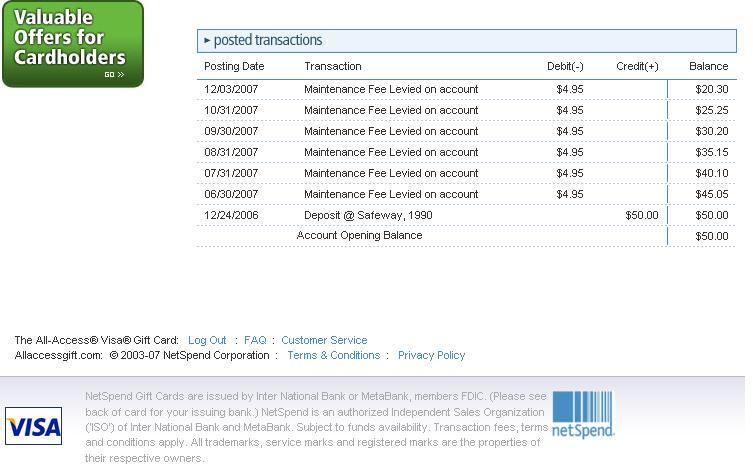
We gave cash, instead of a gift card, to my sister-in-law for her birthday this year. It felt slightly awkward but it saves everyone money.
These gift card charges are just wrong - what has to be maintained that requires almost $5 each month? Is it really that much trouble for Visa to hold on to its customers' funds for more than six months?

(click to enlarge)

Tuesday, September 18, 2007

E*Trade Dies As Fed Cuts Interest Rates

CNN Reports:


Unfortunately, E*Trade can't handle the load. At first, I couldn't get past the login page; now I can't even get the home page:


I guess the timer for their guaranteed two-second execution doesn't start until you can login and place the order.

[ digg this ]

Friday, May 11, 2007

Stock Market's Real Value

Here's an interesting metric which compares the value of the U.S. S&P 500 index to the value of various currencies and commodities.

Monday, April 16, 2007

The Real Value of Money

A couple weeks ago I sold old coins and bills to a collector. I don't know a thing about money collecting and I thought the oversized US dollar bill from the 1920s would fetch more money than any of the 1¢ coins – after all, the dollar bill started off 100x the value of a penny and it was backed by silver.

It turns out that coins made of precious metals are bought by investors and kept in vaults as they await the next run up like we saw in gold and silver in 1979 – the investors don't even bother melting down the coins. A penny, made of silver, clearly has more intrinsic value than a $1 bill back by silver.

From precious metal to paper and, now, to electrons, money has literally lost its value.

Saturday, January 13, 2007

The Perception of Money

How do you view money?

Here are a couple vignettes - what would you do?
(These are academic questions so don't add any "real word" conditions to the story.)

Vignette 1
You visit a bookstore to buy a new book which costs $35. While in the bookstore, you find out that the same book is for sale for $15 in another bookstore in the same mall.
Do you go to the other bookstore to buy the book?

Vignette 2
You visit a car dealer at an auto-park (car mall) to buy a new, $30,000, car. Just as you've decided to make the purchase at the current dealer you find out that another dealer, in the same auto-park, has the exact same car for sale for $20 less. (Let's just say the two cars are indistinguishable and haggling, financing, sales commissions, etc., aren't an issue.)
Do you go to the other car dealer to buy the same car?

Answers
Most people would answer yes to the first vignette and no to the second. When buying a $30,000 car, what's a $20 difference really mean? In actuality, though, there's no difference between the $20 you save when buying a book and the $20 you save when buying a car since $20 has the same, absolute, buying value.