Showing posts with label science. Show all posts

Friday, May 2, 2025

Shared Proof Theory

I enjoy learning new things, especially if it involves a paradigm shift that changes my perspective. But what's a trusted rule that yields objective truth?

Objective truth is a fact or reality that exists independently of individual beliefs, feelings, or perceptions. It’s considered true regardless of who observes or thinks about it.

So, how do I evaluate and arrive at objective truth? I've adopted the following as my own personal philosophy:
If something can’t be shared, measured, or observed, then it’s subjective; it becomes very difficult to prove to others.

In other words, if an experience is accessible only to a single individual, it is subjective; but if it can be seen, tested, or agreed upon by others, it is objective.

We connect through an objective shared reality, while it is the inner, unseen truths that give our connections depth and meaning.


Tuesday, January 30, 2018

Gravity & Time

When we study how the universe behaves, we observe four forces (interactions): electromagnetic force, gravity, strong nuclear force, and the weak nuclear force.

Strong & Weak Nuclear Forces

The strong and weak nuclear forces are not directly observable by us since they operate on the atomic and sub-atomic scale, respectively.

The strong nuclear force is the strongest of the four forces and it's the force that holds matter together. It is approximately 137 times stronger than electromagnetism, a million times stronger than the weak nuclear force, and 1,038 times stronger than gravitation.

The weak nuclear force takes place over a distance of less than the diameter of a proton. It is the mechanism of interaction between sub-atomic particles.

Electromagnetism

Electromagnetism is a universal force we interact with and manipulate. This force travels as wave-particles (photons) and it includes light, heat, microwaves, x-rays, radio waves, etc. Since one of its properties is that it travels as waves, we can constructively and destructively interfere with it. Magnetism, which is part of this force, provides a great example of how this force works when playing with magnets. A north pole and south pole are attracted to each other, while like poles repel each other.

Being able to attract and repel electromagnetism, along with the ability to block it, is a key principle of this force. We pull down a window shade to block out light; we look into a mirror and it reflects (repels) light back at us.


Gravity & Time

Gravity is simply a force that brings all matter together. What prevents the entire universe from lumping together into one big ball of matter is gravity's interaction with the other forces. When climbing a tree and sitting on a limb, I can fell gravity pulling me down while the other forces overcome gravity's pull and keep me (and the tree limb) from falling to the ground.

Time, on the other hand, isn't an actual force. Rather, it's a dimension which can be measured, along with the three spatial dimensions (length, width, and height). Specifically, time is measured by the passage of events. But, on an absolute scale, time can vary which is clearly observed when traveling at speeds close to the speed of light. When a person travels at close to the speed of light, their immediate perception of events seems normal, but their surroundings will be sped up, like watching a time lapse movie. This isn't an illusion. The twin paradox is a thought-experment that illustrates the differences in the passage of time. If one identical twin travels on a rocket at close to the speed of light, they will return to find that their twin, who remained on Earth, has aged more. This phenomenon has been verified by flying a highly accurate atomic clock on an airplane and noticing the time difference when it has returned.

While time slows down as matter approaches the speed of light, there's an asymptote where matter can never reach the speed of light without requiring an infinite amount of energy. Light, on the other hand, is massless and it always travels at the speed of light which, in theory, means time has stopped for a photon of light.

What's interesting about gravity, as well at time, is it only acts in one direction or dimension. There seems to be no anti-gravity at any level. This makes it hard to measure since it can't directly react or be absorbed with a measurement device like, say, a light meter that measures brightness. While we can measure the passage of time, we can't measure its force, especially because that depends of its frame of reference. 

In other words, there's no way to block gravity or travel through time. Perhaps neither one truly exists as a fundamental quality, but rather as a consequence?

Thursday, August 17, 2017

A Perfect Total Eclipse

With all the news about next week's solar eclipse, I was thinking about why we always see the same side of the moon.

The answer is simply because the time it takes the moon to orbit the earth is the same amount of time it takes to rotate on its axis (about 27 days).

That got me thinking... 

Why does the moon nearly perfectly block out the sun during a solar eclipse?

My conclusion, after running some calculations, is that the sun is 400x wider than the moon but it's also nearly 400x farther away.

Feel free to peer review my calculations.

Friday, November 14, 2014

Visiting Home: Lasers, Computers, & Sweatshirts

I spent the last two weeks visiting my mother in my childhood home. It's been a long time since I've spent that much time here. Tonight, as I was packing up, I came across a few things from decades ago.

NAPS

The first thing I came across was my prep school sweatshirt from NAPS. At a quarter of a century old it still looks as good as new.

Naval Academy Prep School

TRS-80

After seeing my old sweatshirt, it piqued my interest to take a peek in the attic. I found my first two personal computers. A TRS-80 Model I and a Model III. I spent many hours writing BASIC and Z-80 assembly on these machines. Without a doubt, these two computers formed the foundation of my career. The Model I was first manufactured in 1977 and the Model III shipped about three years later. The year 1977 was the defining moment for the personal computer industry; it's the year that the first personal computers shipped with a keyboard, monitor, and tape deck for persistent storage. It's the year of the Apple II, TRS-80, and Commodore PET. Out of the gate, Apple set the standard for a personal computer with upper and lower case text and color. I gravitated to the TRS-80 simply because they were sold in Radio Shack computer centers which were easily accessible to me via a two mile bike ride. The only store that carried the Apple II was twice that distance. 

Wrapped up TRS-80 Model I on the left, Model III on the right.

Metrologic He-Ne Lasers

Last, but not least, I came across my two helium-neon lasers that I purchased in junior high school to make holograms in my basement. The process of making my holograms was fairly simple. The most important thing was that there could be no movement more than a half-wavelength of light, otherwise the hologram would be ruined. I wrote about my first hologram a half dozen years ago.

I unboxed my two lasers, tonight, and I was astonished that, after more than 30 years, they both still worked. In the 1980s, laser diode technology was nonexistent for consumers – there were no laser pointers. Helium-neon lasers cost a few hundred dollars and they were the least expensive lasers that I could buy that could be used to make holograms. I spent many months delivering Pennysavers and newspapers to earn enough money to buy the two lasers.

I doubt I'll be using them to make holograms anytime soon. But, who knows?

More than 30 years later, my two He-Ne lasers still lase. 

Saturday, July 27, 2013

Oversimplifying Simplicity

The Way to Eden.
I'm reading Ken Segall's thoughts and experiences while working with Steve Jobs. He's had so much interaction with Steve while at Apple and NeXT that he's a cornucopia of best design and marketing practices.

Segall talks about how "one" is the simplest of concepts. It's an intriguing philosophy – there was even an entire episode of Star Trek dedicate to this concept and its followers.

This belief in "one" is why Apple's mice, track pads, iPhones, etc., from the beginning, have only one button. One is where it all begins.

What's the simplest numeral system? It's not base 10 (decimal) since you have to memorize 10 different digits. Is it base 2 (binary)? After all, computers and human DNA use binary to store information (ones and zeros, or A-T and C-G combinations). Certainly binary is the simplest? Au contraire; how many people can convert 1010 from binary to base 10? Not simple... not simple at all.

The simplest numeral system.
It turns out that unary is the simplest numeral system for representing natural numbers – in other words, unary uses just ones. This is how a cave man would keep track of "How many?" things he owed, even before there was written or spoken language. Take a pile of rocks and for each one of something, you move a rock to another pile. Do the reverse when taking inventory.

This is how a bouncer counts people at the door or how the simplest of card counters tries to beat the house at blackjack. We've all used unary to keep track of things when we tally items with four slashes and then a diagonal.

Something Simpler?
Where I disagree with Segall's thinking is when he points out "zero is the only number that's simpler than one." Ironically, this not the case as I learned from my assembly language professor, Mr. Lee. If you think back to when we learned Roman numerals in grade school (I, II, III, IV...) you'll quickly realize that there was no numeral for zero. This is also true in other ancient civilizations' numeral systems such as Chinese and Arabic. As simple as zero seems, it's a fairly complex concept to have nothing of something – just try to ask any handheld calculator to divide by zero and you'll see that it does not compute.

Trying to be simpler than the simplest makes things more complex.

Tuesday, May 15, 2012

Soyuz Launch of Expedition 31

Last Night's 23:01 EDT Launch
Last night (aka today, if you were in Russia) I watched the lift off of Expedition 31 which put three men into orbit aboard the Russian Soyuz rocket. Although it only takes about eight or nine minutes to get into orbit, it'll be about two days until they rendezvous with the ISS. One member of the crew, Joe Acaba, was the only American and he'll be spending a few months aboard the ISS.

Last night's 23:01 EDT liftoff was the first time that I watched a live launch of a Soyuz rocket. Since it doesn't have solid rocket boosters, like the space shuttle, it burns very clean like the old Saturn V rockets.

Astronauts Shane Kimbourgh (L) and Joe Acaba (R)
I was amazed at the elegant simplicity of the entire Soyuz launch system. It's moved out to the launch site via a railroad just a few days before launch and it's propped up on what are essentially a few pegs. The pegs act as the levers of its tower support systems (imagine stepping on the tines of a rake - the wooden shaft of the rake will pop up). At lift off, once the weight of the rocket is no longer on the pegs, the towers fall back just like stepping off a rake.


What makes this launch system so elegant is that it inherently works - you don't have to rely on electrical or hydraulic systems for the supporting towers to move away at launch.


The video of the ride to orbit looked very smooth inside the capsule. The only downside that I could see is that it's cramped. I hear that the return landing is very bumpy for the crew since the capsule lands on the ground, not in the ocean, like the Apollo capsules, or on a landing strip like the space shuttle.

Saturday, April 14, 2012

Easter Nostalgia

Last weekend was one of the first times, in a long time, that I've been back to where I grew up for a holiday weekend.

It was a beautiful Easter weekend as Laura and I flew from Morristown to Farmingdale's Republic Airport. While it was a little breezy, there wasn't a cloud in the sky.

My sister had been asking to go up for a ride in my plane; so she came down to the airport and snapped some great photos as we flew over Huntington and the Long Island Sound.

On Easter Sunday, I went to church with my mother and sister. The last time I was at this church was on Valentine's Day (our wedding anniversary) in 2007 as I stood on the church altar to deliver my father's eulogy during an ice storm that made the headlines. The offering hymn was one of my favorites, Lord of the Dance, which most any Marine, who's gone through boot camp on Parris Island, could never forget.

One thing that I had completely forgotten about was the holography lab that I had set up in my childhood basement when I was in junior high school. The solid basement foundation was ideal for making holograms since any movement more than a few hundred nanometers, during the 6-12 second exposure, would ruin it.

On the wall of my holography lab, I had painted a diagram of a ruby laser, which was the first type of laser invented in 1960. (Ironically, you can't make a hologram without a laser, yet the hologram was invented about a dozen years before the laser.)

As an early teen, my budget was rather limited. It had taken me many months to save up enough money to buy my first two lasers. In the early 1980s, diode lasers did not exist as consumer devices, like they do today, and I had to buy much larger and more expensive helium-neon lasers.

Since my budget as a 13-14 year old was limited, I didn't have enough money to buy all of the metal letters which I had started to use to label the parts of my ruby laser drawing.

My ruby laser diagram may look like a cave painting in ruins, but it's actually never been completed. I doubt it every will.

Saturday, January 28, 2012

Special Relativity Time Dilation

I recently had a conversation where I was explaining why time slows down as you travel near the speed of light.

The explanation is rather simple if you think of light as particles, like bullets, called photons. One beauty of light is that it moves at a constant rate when traveling through a vacuum or medium. It doesn't move faster or slower unless you change the medium it's traveling in.

Thought Experiment
Imagine that you're standing at a fixed distance from a clock. As light reflects off the clock, it strikes your eyes at a fixed rate such that the clock's second hand sweeps at the same rate. Time is ticking away like normal.

Now, imagine if you are moving away from the clock at near the speed of light. Since the photos (bullets) are moving at a fixed rate, it will take longer and longer for each particle, reflected off the clock, to catch up with you. Therefore, you'll experience the sweeping of the clock's second hand at a slower rate. Hence, time appears to slow down - the clock looks as if it's running slower.

But, time isn't really slowing down. The watch on your wrist will mark time normally from your point of view. From the point of view of the clock, which is also marking time normally, it will look as if you're slowing down, too.

Further Reading
While this is a naive application of time dilation, since acceleration and deceleration must be taken into account, it really does appear that time slows down when traveling away from an observer at the speed of light. A more interesting observation is the twins paradox where one traveling twin ages slower than his other, non-traveling twin.

Thursday, July 23, 2009

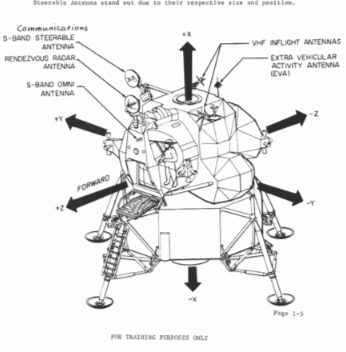
Lunar Module Instruction Manual & STS-127

Many years ago, my neighbor, Wynne Trenholme, who's now in his mid 90s, gave me several lunar module training manuals. Tonight, I scanned one of manuals into a PDF (Introduction to the Lunar Module programmed text, March 1969). This manual introduces the student astronaut to the LM's electrical power and environmental controls along with explosive devices and propulsion & reaction controls as well as some other lunar module systems.

The other two manuals I have which are equally as fascinating:
1. Self Instruction Programmers Study Guide Lunar Module, October 1968.
2. Untitled, April 1969. This manual contains mostly diagrams of the LM-5 (Eagle).

Diagram from Introduction to the Lunar Module

Click to enlarge

I've always been fascinated by the Apollo program. Especially the lunar module since it was built where I grew up (Long Island) and it was the first spacecraft designed to work entirely in the vacuum of space.

Over the past few weeks, my interest in the space program has been re-energized for two reasons. First, because of the 40th anniversary of the Apollo 11 mission. Second, because a college classmate of mine, Chris Cassidy, is currently in orbit on the space shuttle Endeavour (STS-127). I travelled to Florida to watch Chris's launch. It will probably be the only shuttle launch I'll see since there are only seven more planned before the space shuttle is retired.

Click to enlarge photos below.

Lift off of Endeavour (15 July 2009)


Presenting Cassidy with a USNA 1993 ball cap to bring into space.


Cassidy's first EVA lasted 5 hours 59 minutes. (22 July 2009)
Image Credit: NASA

Monday, October 27, 2008

He-Ne @ 632.8 nm

Click to enlarge

My First Laser & Holography Kit
When I was in 8th grade (1981) I took a trip to Bellmawr, NJ (not far from Edmund Scientifics) to buy my first laser from Metrologic Instruments. Back then, laser diodes didn't put out much power so helium neon was the only practical option I could afford from delivering Pennysavers and newspapers.

The laser in this photo is a modulated laser which means that you could plug in a crystal microphone and talk over the beam of laser light. I purchased this one, and a few months later I purchased polarized laser, to make holograms in my basement.

Originally, I intended to build a sandbox to make the holograms but I found a clearance holography kit at Edmund Scientifics. The kit was basically 2' x 2' piece of black Plexiglass on black foam with some screw holes to hold an optical diffuser (not a lens), front surface mirror, and film holder.

My first hologram was my best because I didn't know that you shouldn't recycle photographic developer chemicals. It was a hologram of Boggle cubes (dies with letters on each side) that misspelled Hologram. (I originally spelled it correctly, but when I moved the holography kit to the darkroom lab I hastily set up the cubes incorrectly.)

I was definitely the only kid in school who owned a laser... actually two lasers.

Saturday, March 29, 2008

Shuttle Launch

This is one of my favorite photos of the space shuttle launching.

You'd think that the shuttle goes straight up, but that wouldn't put it into orbit. Getting into orbit it like firing a cannon ball that "misses" the Earth and just keeps missing. For every 10 feet the Earth's surface curves down, the shuttle drops 10 feet. So, astronauts on the shuttle aren't floating because there's no gravity, but rather because they're in a constant free fall called microgravity.


Sunday, September 30, 2007

Humanity Destined Since Big Bang

A simple theory is that, since the Big Bang, humanity has been predetermined to exist.

Let's presume no intervention by a supernatural being and also, let's presume consistent physical laws from a macro (newtonian) through a micro (quantum) level.

For systems with a small number of particle interactions, for example our solar system, we can predict with great accuracy, eclipses, phases of the moon, and sunrise & sunset. To predict these, we only need to concern ourselves with three objects (Earth, sun, and the moon).

But, for us to calculate systems with many more particles, such as the weather on Earth, it becomes more difficult. Although the roll of a die may seem random, it's not - we just can't calculate all the variables involved.

Let's suppose, for argument sake, that there is no other life in the universe. That would mean, since the Big Bang, 15 billion years ago, that intelligent, sentient and sapient life was destined to arise on Earth.

Considering that a universe (or any system) devoid of life would be devoid of free will, then the first life evolving anywhere in our universe was destined to happen.

Which raises an interesting point about free will. If an entire human's existence is destined by the laws and interactions of physics how do we generate true randomness which we call free will?